
Upmarket
Enterprise buyers decide differently than the customers you have today.
Enterprise buyers, longer cycles and buying committees demand a different Marketing motion. I help you build the capabilities larger customers expect.
Enterprise Marketing Readiness
Is your Marketing ready for Enterprise Sales?
Moving into Enterprise Sales changes more than your Sales team. Enterprise buyers take longer to decide, buy as a committee, and expect a different experience along the way. The diagnostic shows where your Marketing is already prepared for that — and where the biggest gaps are.
Readiness level
Developing
3 priority moves identified.
- Sales & Marketing Alignment71%
- ICP & Account Prioritization58%
- Measurement & Impact42%
Illustrative preview — your brief is personalized.
Why it's different
Four reasons enterprise buying has changed
internal stakeholders
The average enterprise decision now runs through 13 people. You're not helping one buyer — you're helping a whole committee reach agreement.
Forrester
of the buying journey
Buyers spend only a small share of their journey talking to suppliers. Most of the decision happens before Sales is ever involved.
Gartner
start with a preferred vendor
Most buyers already have a vendor in mind before they reach out. The work of winning starts long before a deal shows up in the CRM.
Forrester
of buying teams hit internal conflict
Buying groups often struggle to agree. Marketing can help them get aligned before Sales enters the conversation.
Gartner
What I evaluate
The five capabilities I look at when companies move into Enterprise Sales
Enterprise Sales changes the rules. I evaluate five capabilities that show whether Marketing is ready to support larger buying committees, longer buying cycles and more complex commercial decisions.
Marketing & Sales Alignment
Marketing and Sales work towards the same commercial goals.
ICP & Account Prioritization
Marketing focuses on the companies most likely to become enterprise customers.
Commercial Go-to-Market Strategy
Marketing supports the entire buying committee, not just one champion.
Commercial Operating Model
Marketing becomes part of the commercial organization, not a separate function.
Measurement & Marketing Impact
Marketing sees buying momentum before opportunities appear in CRM.
Curious where your Marketing stands?
Take the Marketing Readiness Diagnostic and get a personalized Executive Brief in about 3 minutes.
InsightSync Platform
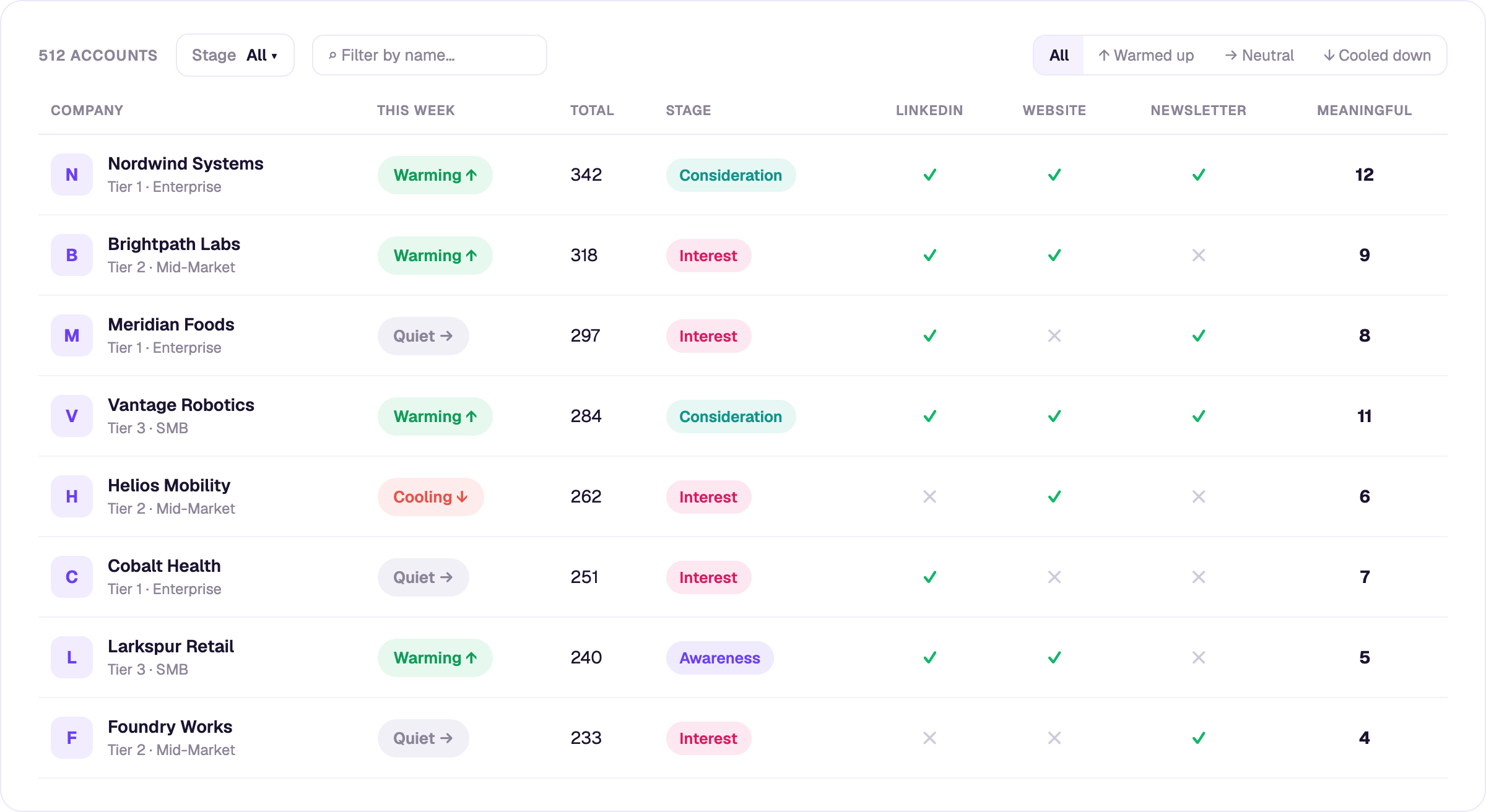
Know if you're winning your enterprise accounts.
Account-based Marketing, in one shared view for Sales and Marketing. Understand whether your marketing and sales activities are warming the right target accounts, and act before the deal is decided.
How I help
How I help you build the capabilities enterprise buyers expect
The logical next step after the diagnostic. I work hands-on alongside Marketing and Sales, not at arm's length, and build the commercial motion larger buying committees expect.

I connect Marketing and Sales, turn account insights into action, and help you drive enterprise growth.
— Michaela Munitzk
A Scored Target Account List
Together we score your market and pick the accounts most likely to become enterprise revenue. Marketing works a named list, not the whole market.
Messaging for the Buying Committee
We rework your positioning for every role on the committee, not one champion. You get messaging that gives each stakeholder a reason to say yes.
A Map of Who Really Decides
We make visible who sits on the committee and what each person needs to move. Sales walks in knowing the room, instead of guessing it.
Enablement Sales Actually Uses
We build the content and enablement for complex, multi-stakeholder deals. Not a library nobody opens, but the few pieces that move a committee.
One Commercial Motion, Clear Handoffs
We put Marketing and Sales on one motion and define who owns what at each handoff. Fewer accounts stall in the gap between the teams.
Account Signals Before the CRM
We set up reporting that shows account engagement and Marketing's contribution before pipeline lands in CRM. You steer deals while they're still forming.
Ready to build the Marketing enterprise buyers expect?
Whether you're preparing for Enterprise Sales or already scaling into it, I'm happy to help.
FAQ
Questions I get asked about Enterprise Sales and Marketing
The ones that come up most often when a company decides to sell to larger customers.
How should Marketing change when moving into Enterprise Sales?
Marketing stops working the market and starts working a list. The shift sounds small. It isn't, because it changes what Marketing is for. When you're selling to smaller customers, Marketing's job is largely to hand Sales enough leads. Once you're selling to enterprise, the job becomes making a short list of accounts easier to win.
In practice that means fewer campaigns and more depth. You learn who sits in the room on those deals, and you build content that helps those people make your case internally, on the days you're not there.
What changes when selling to Enterprise customers?
Almost everything about the pace and the shape of the deal. The decision runs through a group, so there's no one person you can convince and be done. Cycles get longer, procurement and security reviews appear, and a deal can stall for reasons nobody tells you about.
The part that catches teams out is the internal work. Your buyer has to sell you inside their own company, to people you'll never meet. Most of what decides the outcome happens in rooms you're not in.
How do buying committees affect Marketing?
They break the single-persona habit. Most Marketing is built for one job title, the one on the ICP slide. An enterprise deal has a security reviewer, someone in finance, an end user who'll have to live with the thing, and an executive sponsor who only cares about two of the twelve reasons you think you're good.
If your messaging only speaks to one of them, the others have no reason to move, and the deal drifts. A practical first step: map the committee on your last three won and lost deals. Who was actually in the room, and what did each of them need to believe? The gaps in that map are usually the gaps in your content.
What KPIs matter in Enterprise Marketing?
Account-level ones. Lead counts still tell you something, but they can't answer the question that matters at this stage: which accounts are moving, and are they the accounts you chose?
A few that earn their place: how much of your target list shows real engagement, how many roles inside an account you're actually reaching (one contact at a large account isn't coverage), pipeline created inside the target list rather than pipeline overall, and win rate on the accounts you said mattered.
You don't need a new tool for this. A simple cold / warming / hot view of your target accounts, updated monthly, tells you more than most dashboards, because it shows Marketing moving accounts before Sales sees it.
How do you know if your Marketing is ready for Enterprise Sales?
There's a quick version of this test. Ask your Head of Marketing and your Head of Sales, separately, to write down what makes an account worth pursuing. If the two answers don't match, that's your finding, and it's a common one.
A few more signs, less comfortable to look at. Sales is building its own decks because Marketing's don't survive a committee. The pipeline looks full, but the enterprise deals in it don't convert. Nobody can say which target accounts got warmer this quarter.
If you want the structured version, the Marketing Readiness Diagnostic walks through twelve questions across the five capabilities on this page and gives you a personalized Executive Brief. It takes about three minutes.
Should Marketing still measure MQLs?
Keep them if they're doing a job. Plenty of teams drop MQLs because it feels like the modern thing to do, then lose the one number their board recognized. The metric is fine. What breaks is leaving it as your headline number after you've moved upmarket.
An MQL says one person did something. An enterprise decision needs a group to agree. So a single MQL from a 5,000-person company barely tells you anything on its own, and a quarter of strong lead numbers can sit alongside no enterprise pipeline at all.
Keep MQLs as one input, and stop reporting them as the result. Budgets get cut on the metric that's easiest to see, not the impact that's real. If lead count is the only thing leadership sees, that's what you'll be judged on.
How should Sales and Marketing work together in Enterprise Sales?
On the same accounts, to the same definition, with a standing conversation between them.
The definition is where most teams should start. One written description of what makes an account qualified, signed off by both leaders. It sounds administrative, and it settles more arguments than any process change.
After that it's mostly rhythm. Sales usually knows which accounts are becoming active long before Marketing sees it in a dashboard, and that information needs somewhere to go. Fifteen minutes inside an existing weekly Sales meeting is enough to start.
The handoff deserves attention too, because complex deals tend to fall apart there. Rarely because someone drops the ball. More often because nobody agreed who owns the account between “engaged” and “opportunity.”
What is the biggest mistake companies make when moving upmarket?
Changing the Sales team and leaving Marketing exactly as it was.
It's an easy mistake to make, because it doesn't look like a mistake for a while. You hire enterprise AEs, maybe a Sales Engineer, you raise the number. Marketing keeps running the motion that worked: more content, more leads, more campaigns. The old motion still kind of works, so nobody stops to question it. Until it doesn't.
Teams rarely struggle here because people aren't working hard enough. They struggle because the business changed faster than the way Marketing works. The fix is rarely a bigger budget. It's usually deciding, out loud, that Marketing's job is now different, and then changing what it's measured on.